Quadratic Equation Solver with Steps
Solve any quadratic equation and see every step of the work.


Free download. AI explanations and dark mode need the optional PRO subscription.
Try it now
Step by step
- Start from the quadratic formulax = −b ± b2 − 4ac2a
- Substitute a, b and cx = −(−2) ± (−2)2 − 4(1)(−15)2(1)
- Work out the discriminant, b² − 4acΔ = (−2)2 − 4(1)(−15) = 64
- The discriminant is a perfect square, so the roots are rational64 = 8
- Take the plus branchx₁ = 2 + 82 = 5
- Take the minus branchx₂ = 2 − 82 = −3
Also worth knowing
- Vertex
- (1, −16)
- Axis of symmetry
- x = 1
- Discriminant
- 64
- Parabola opens
- upward
- Factored form
- (x − 5)(x + 3) = 0
Want this explained in plain English, offline, in dark mode? That is what the app adds, with PRO.
What it does
Quadratic Equation Solver
Enter the coefficients of any equation in the form ax² + bx + c = 0. This calculator returns both roots, the discriminant, the vertex and the factored form, and shows the full quadratic-formula derivation underneath — including equations whose roots are complex.
Both roots, always
Real, repeated or complex — the solver handles every case instead of erroring out.
Full derivation
Every substitution into the quadratic formula is written out, not hidden behind a paywall.
Discriminant first
See b² − 4ac and what it tells you about the roots before the arithmetic starts.
Vertex and factored form
The extra forms you actually need for graphing and homework, computed automatically.
How it works
Three steps to an answer
Enter your coefficients
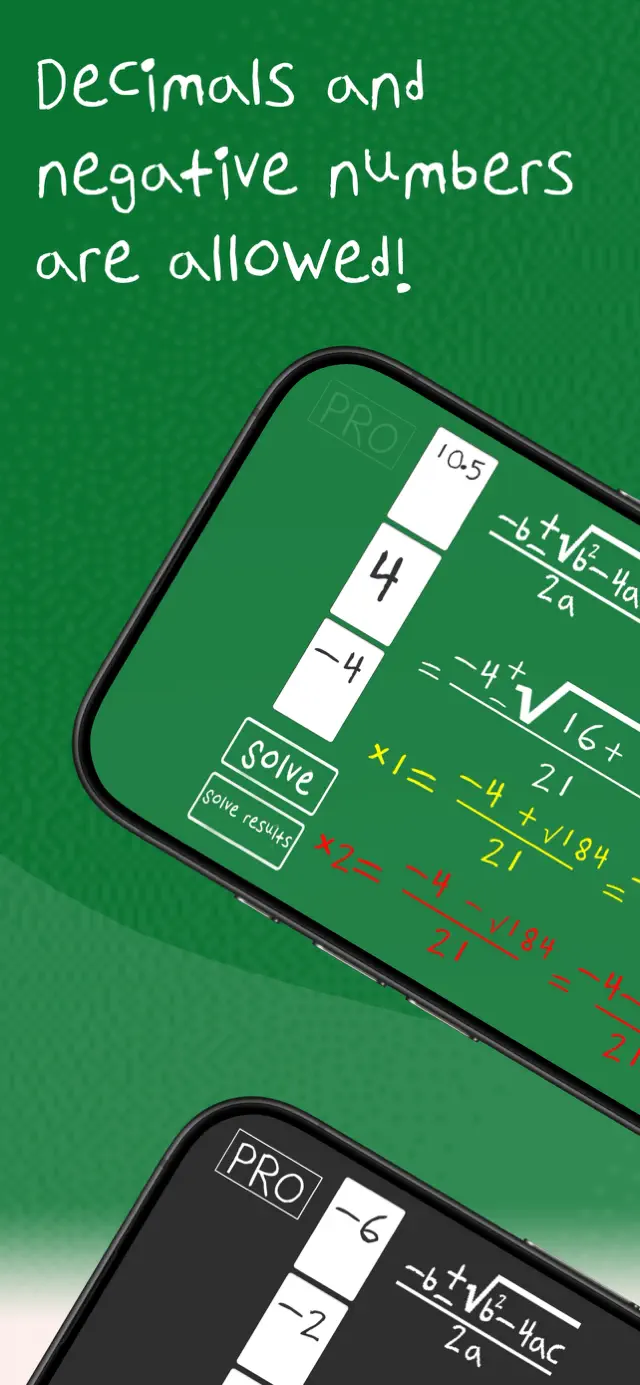
Type a, b and c from your equation ax² + bx + c = 0. Decimals and negatives are fine.
Read the discriminant
The calculator shows b² − 4ac immediately, so you know what kind of roots to expect.
Follow the steps
The full quadratic-formula substitution appears below the answer, line by line.
Guides
Learn the method, then check your work
Each guide walks through one kind of problem end to end, then drops the numbers straight into the calculator above.
Using the Quadratic Formula
Identify a, b and c, substitute carefully, and work outward from the discriminant.
Read the guide →The Discriminant Explained
One number that tells you how many roots there are, before you find them.
Read the guide →Quadratics with Complex Roots
When the discriminant goes negative, the answer uses i — and it is still an answer.
Read the guide →Solving x² + 5x + 6 = 0
One equation, solved three different ways, with all three compared.
Read the guide →Which Method Should You Use?
Three methods, three situations. How to pick in about five seconds.
Read the guide →Vertex and Axis of Symmetry
x = −b ÷ 2a gets you there, and the rest follows from substituting.
Read the guide →Sum and Product of Roots
The roots add to −b/a and multiply to c/a. A fast check on any answer.
Read the guide →Quadratic Word Problems
Projectiles, areas and profit — and knowing which root to throw away.
Read the guide →Solving 2x² − 4x − 6 = 0
What to do when a is not 1 — and the shortcut most people miss.
Read the guide →In the app
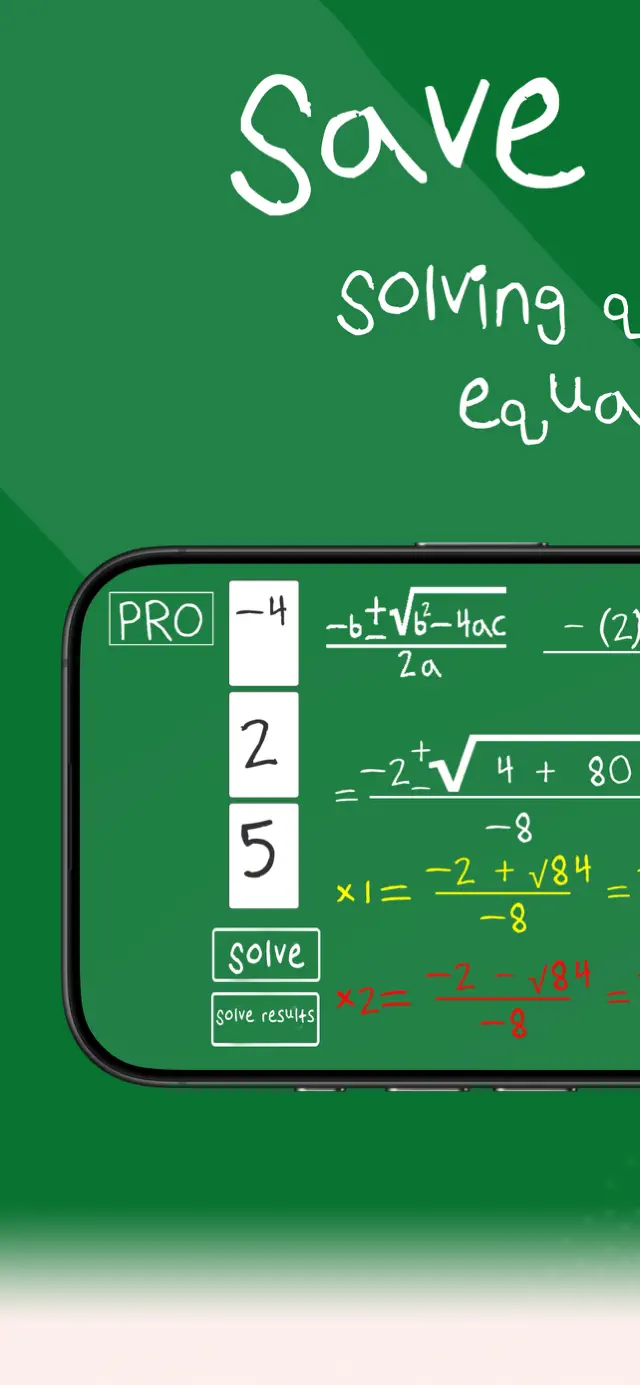
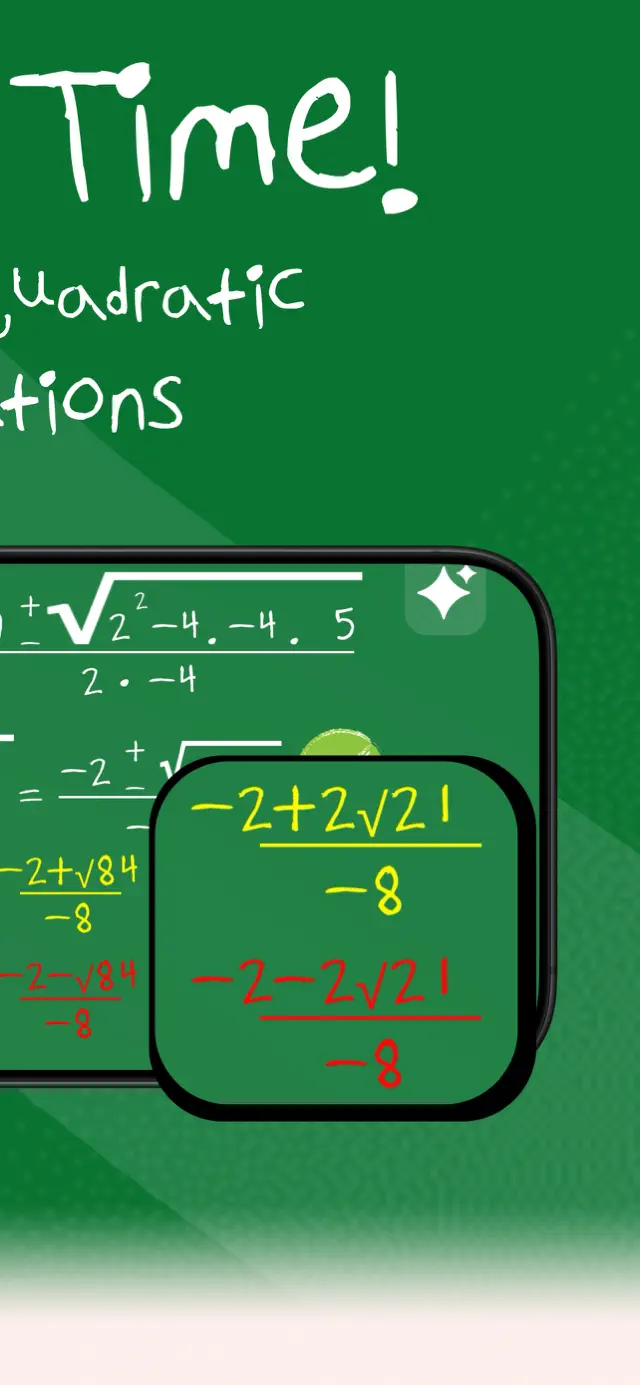
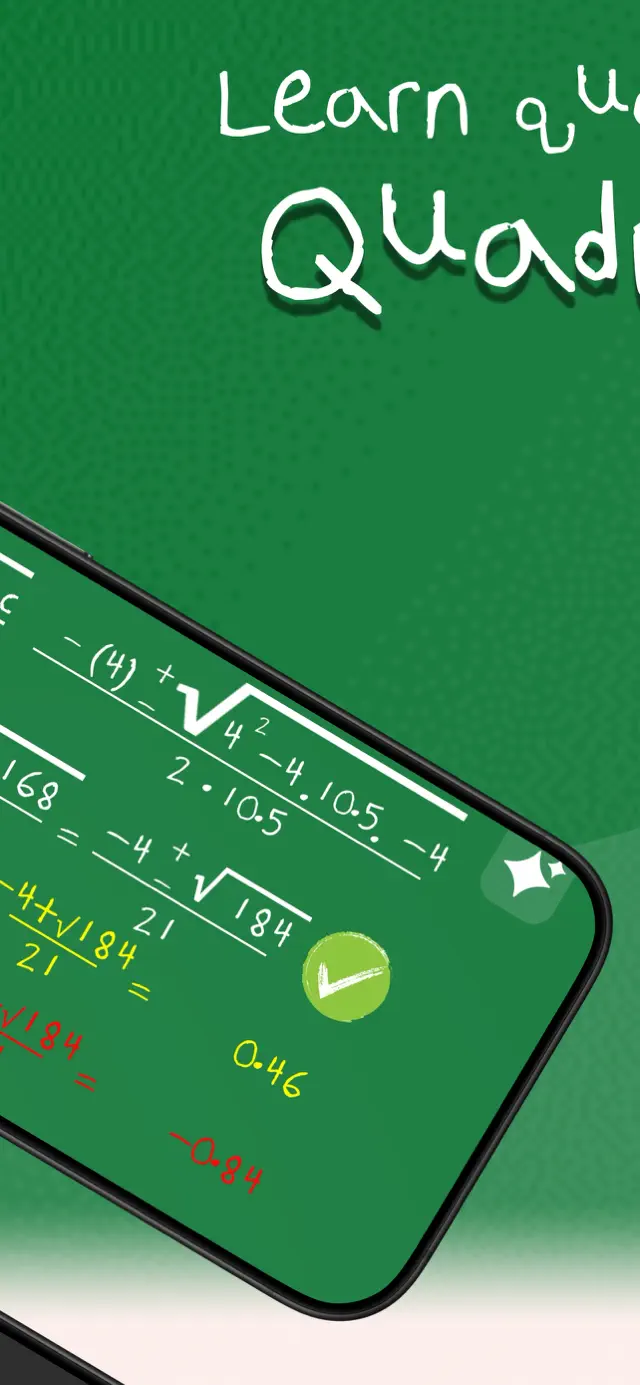
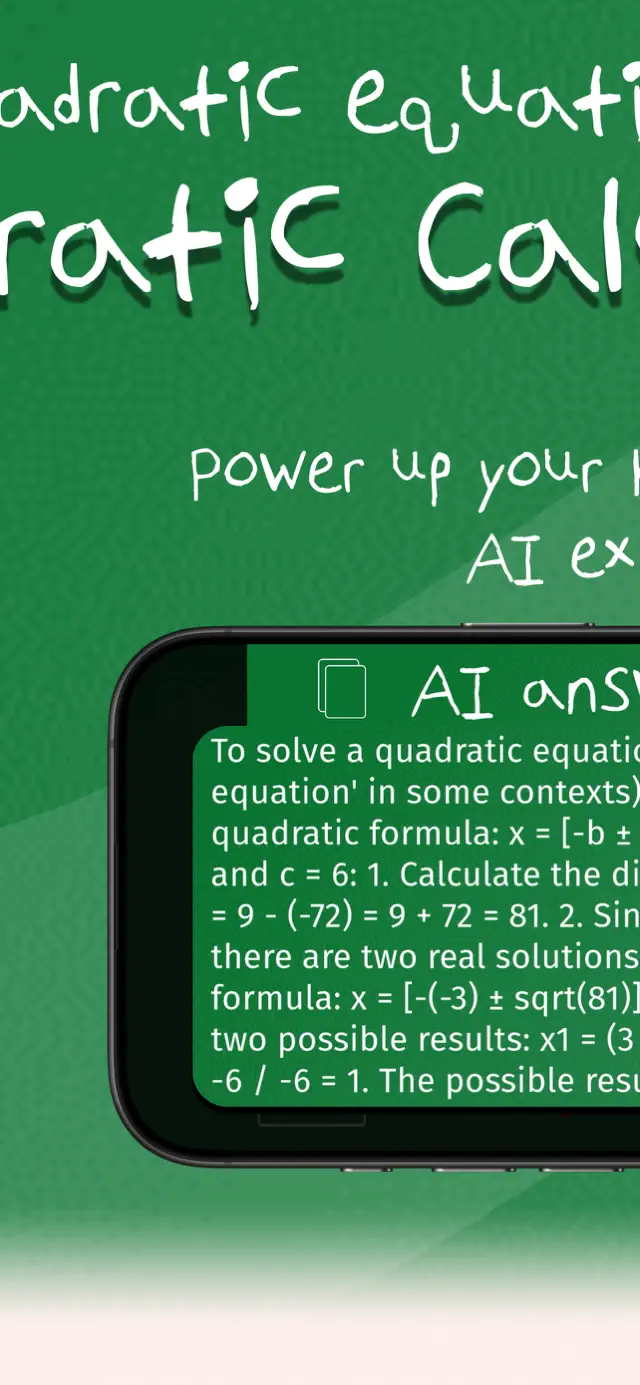
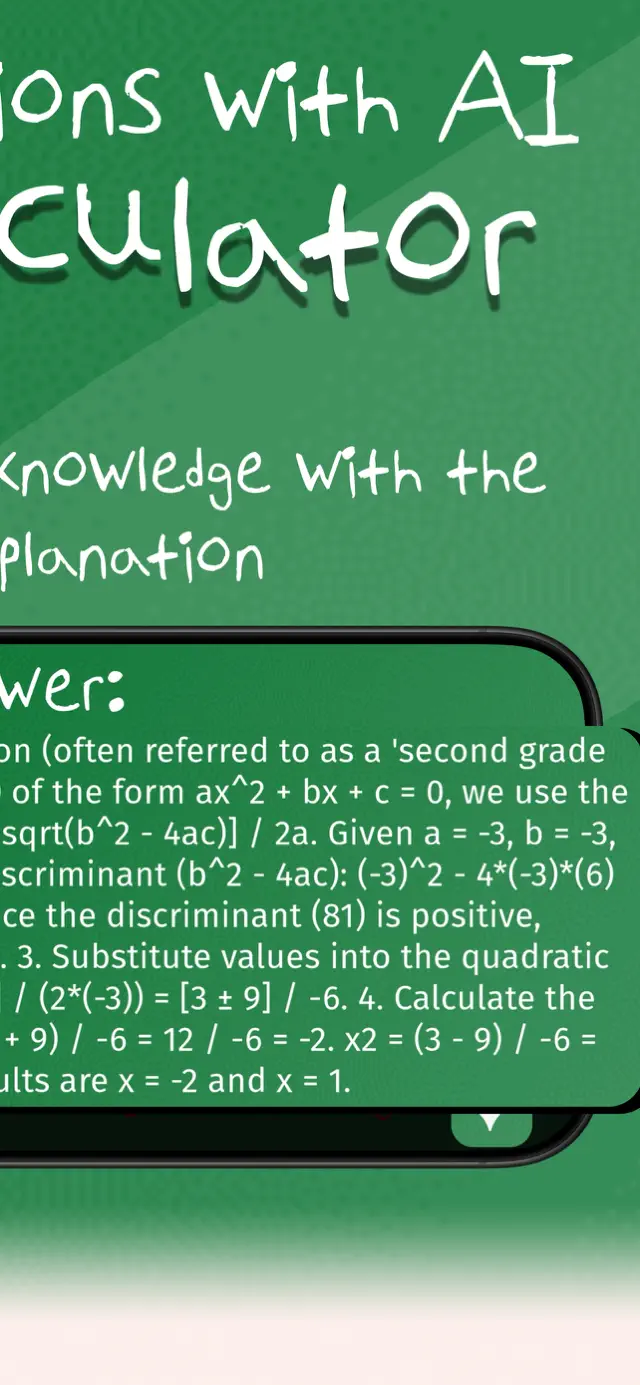
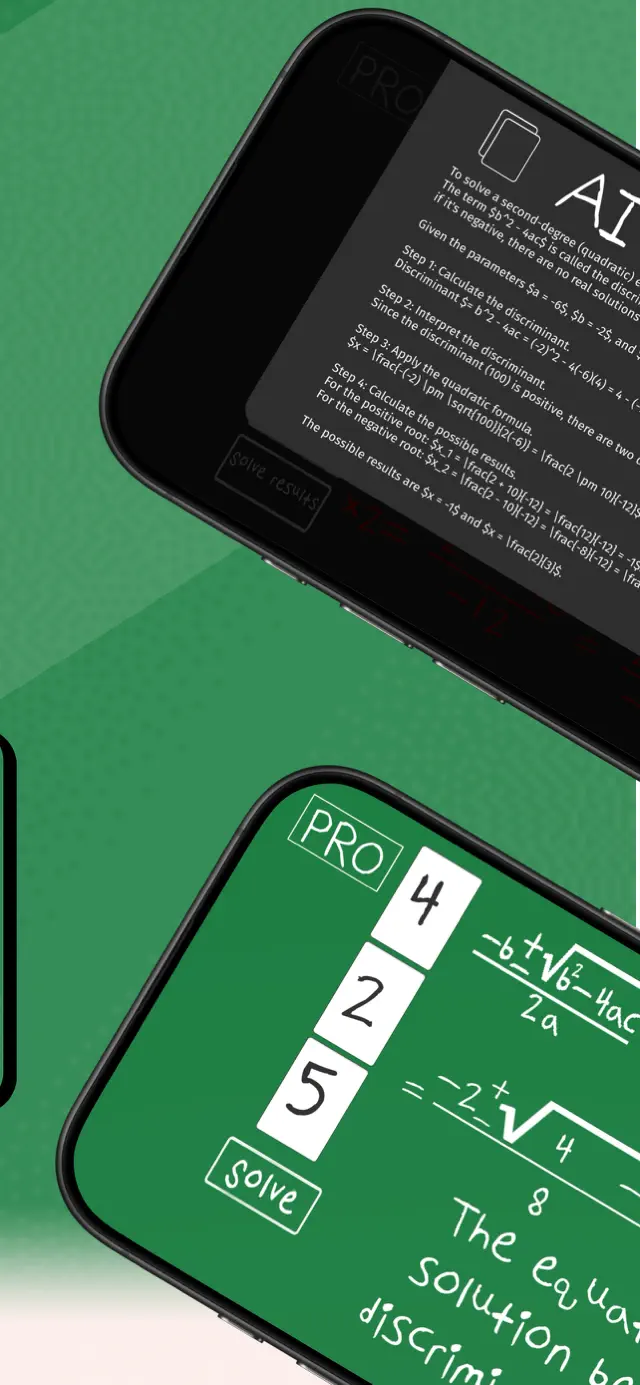
What Quadratic Equation Solver looks like on your phone
The same calculator, built for touch — plus the AI explanation and dark mode that come with PRO.
FAQ
Questions people ask
What is the quadratic formula?
For an equation ax² + bx + c = 0, the solutions are x = (−b ± √(b² − 4ac)) ÷ 2a. The part under the radical, b² − 4ac, is the discriminant, and it determines how many real roots the equation has.
The formula, step by step →What does the discriminant tell you?
If b² − 4ac is positive there are two distinct real roots; if it is zero there is one repeated root; if it is negative the roots are a complex conjugate pair and the parabola never crosses the x-axis.
What the discriminant means →Can this solver handle complex roots?
Yes. When the discriminant is negative the calculator returns the roots in a ± bi form and shows how the imaginary part was separated out.
Complex roots explained →What if a equals zero?
Then the equation is not quadratic — the x² term disappears and it becomes the linear equation bx + c = 0. The calculator detects this and solves it directly instead of dividing by zero.
Does it show the vertex and factored form?
Yes. Alongside the roots the calculator gives the vertex, the axis of symmetry, the discriminant and the factored form, which are the values homework questions usually ask for next.
Vertex and axis of symmetry →Take Quadratic Equation Solver with you
The app adds plain-English AI explanations, dark mode, and works offline — useful when there is no signal or the exam hall has no Wi-Fi.
Free to download. AI explanations and dark mode are part of the optional PRO subscription.