Rule of Sarrus Calculator for 3×3 Determinants
Find the determinant of any 3×3 matrix, with the diagonals drawn for you.


Free download. AI explanations and dark mode need the optional PRO subscription.
Try it now
Step by step
- Copy the first two columns to the right of the matrix22−5223153172.2672.2
- Multiply along the three diagonals going down-right, and add them2 × 1 × 6 + 2 × 5 × 7 + (−5) × 3 × 2.2
- That gives the positive part of the determinant12 + 70 + −33 = 49
- Multiply along the three diagonals going up-right, and add them7 × 1 × (−5) + 2.2 × 5 × 2 + 6 × 3 × 2
- That gives the part to be subtracted−35 + 22 + 36 = 23
- Subtract the second sum from the firstdet = 49 − 23 = 26
Want this explained in plain English, offline, in dark mode? That is what the app adds, with PRO.
What it does
Sarrus Rule Calculator
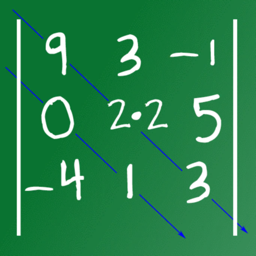
Enter the nine entries of your 3×3 matrix. The calculator applies the rule of Sarrus — copying the first two columns to the right, then taking the six diagonal products — and shows each product as it goes, with the diagonals drawn so you can see where every term comes from.
The diagonals, drawn
The three down-diagonals and three up-diagonals are drawn over your matrix, colour-coded.
All six products shown
Every diagonal product is listed with its sign, so you can check your own work term by term.
Built for 3×3
A dedicated tool rather than a general matrix calculator that buries the Sarrus method.
Tells you what it means
A zero determinant is flagged, along with what that says about invertibility.
How it works
Three steps to an answer
Fill in the matrix
Enter all nine values. Decimals and negatives are supported.
Watch the diagonals
The first two columns are copied to the right and the six diagonals are drawn.
Check each product
Every diagonal product appears with its sign, then they are summed to the determinant.
Guides
Learn the method, then check your work
Each guide walks through one kind of problem end to end, then drops the numbers straight into the calculator above.
How to Use the Rule of Sarrus
The method in full: copy two columns, take six diagonal products, subtract.
Read the guide →Determinant of a 3×3 Matrix, Step by Step
Both methods side by side, with the same matrix worked through each.
Read the guide →Sarrus Rule vs Cofactor Expansion
Same answer, different work. When each method is genuinely faster.
Read the guide →What a Zero Determinant Means
Singular matrices, dependent rows, and why the inverse stops existing.
Read the guide →Cramer's Rule for 3×3 Systems
Four determinants, three divisions, and the answer to a 3×3 system.
Read the guide →Determinants, Cross Products and Volume
Why the determinant of three vectors is the volume of the box they span.
Read the guide →Why Sarrus Only Works for 3×3
The counting argument: 6 diagonals, 6 terms — and why 4×4 breaks it.
Read the guide →How to Check if a 3×3 Matrix Is Invertible
One determinant is the whole test — plus what to do with the answer.
Read the guide →A Full Sarrus Worked Example
One matrix, all six products written out, nothing skipped.
Read the guide →In the app
What Sarrus Rule Calculator looks like on your phone
The same calculator, built for touch — plus the AI explanation and dark mode that come with PRO.






FAQ
Questions people ask
What is the rule of Sarrus?
The rule of Sarrus is a method for finding the determinant of a 3×3 matrix. You copy the first two columns to the right of the matrix, multiply along the three diagonals running down-right and add them, then multiply along the three running up-right and subtract them.
Read the full method →Does the rule of Sarrus work for 4×4 matrices?
No. A 4×4 determinant has 24 terms but the Sarrus diagram only produces 8 diagonals, so it would miss two thirds of the answer. Use cofactor expansion or row reduction for anything larger than 3×3.
Why it stops at 3×3 →What does a determinant of zero mean?
The matrix is singular. It has no inverse, its rows are linearly dependent, and as a transformation it flattens 3D space onto a plane, line or point.
What zero determinants mean →Is Sarrus faster than cofactor expansion?
For a dense 3×3 matrix, yes — six products and one subtraction. But if a row or column contains zeros, cofactor expansion is faster, because each zero removes an entire term from the calculation.
Compare the two methods →How do I know if a 3×3 matrix has an inverse?
Compute its determinant. Any non-zero value means the matrix is invertible; zero means it is singular and no inverse exists. That single number is the complete test.
The invertibility test →Can I use decimals and negative numbers?
Yes. Every cell accepts decimals and negative values, and the working shows the signs explicitly so you can follow how they propagate through the six products.
Can this calculator help with Cramer's rule?
Yes. Cramer's rule needs four 3×3 determinants — one for the coefficient matrix and one for each variable — and this calculator computes each of them with the steps shown.
Cramer's rule step by step →Take Sarrus Rule Calculator with you
The app adds plain-English AI explanations, dark mode, and works offline — useful when there is no signal or the exam hall has no Wi-Fi.
Free to download. AI explanations and dark mode are part of the optional PRO subscription.